|
|
The Holy Prophet Samuel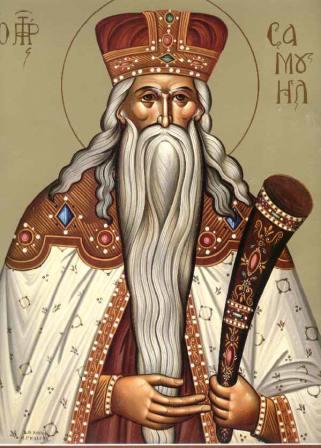 The fifteenth and last of the Judges of Israel, he lived eleven hundred years before Christ. He was of the tribe of Levi, born of Elkanah and Hannah in a place called Ramatha or Arimathea, where noble Joseph was later born. The barren Hannah besought Samuel of the Lord with tears, and dedicated him to God when he was three years old. Living in Shiloh near the Ark of the Covenant, Samuel, at the age of twelve, had a true revelation from God of the punishment which would come upon the house of the High Priest, Eli, because of the worthlessness of his sons Hophni and Phineas. This revelation was swiftly fulfilled: the Philistines routed the Israelites, slew both of Eli"s sons and captured the Ark of the Covenant. When the messenger brought these bad tidings to Eli, he fell dead on the ground, breathing his last at the age of ninety-eight, and the same thing happened to his daughter-in-law, the wife of Phineas. Israel was under the Philistine yoke after this for twenty years. When this time had elapsed, God sent Samuel to the people to preach repentance to them as the one means of their salvation from their enemies. The people repented and cast out the foreign idols which they had served, accepting Samuel as prophet, priest and judge. Then Samuel set out with the army against the Philistines and, with God"s help, put them to confusion and slew them, freeing the land and the people. After that, Samuel judged the people in peace to old age. Seeing him growing old, the people asked him to give them a king in his place. In vain, Samuel urged the people against this, saying that God was their only king, but the people remained adamant in their desire. Although this desire was not pleasing to God, He commanded Samuel to anoint Saul the son of Kish, of the tribe of Benjamin, as king. Saul reigned a short time, and God rejected him for impudence and disobedience, and then commanded Samuel to anoint David the son of Jesse as king in Saul"s place. At the time of his death, Samuel gathered all the people together and took leave of them, and when he died all Israel wept for him and buried him solemnly in his house at Ramah. The fifteenth and last of the Judges of Israel, he lived eleven hundred years before Christ. He was of the tribe of Levi, born of Elkanah and Hannah in a place called Ramatha or Arimathea, where noble Joseph was later born. The barren Hannah besought Samuel of the Lord with tears, and dedicated him to God when he was three years old. Living in Shiloh near the Ark of the Covenant, Samuel, at the age of twelve, had a true revelation from God of the punishment which would come upon the house of the High Priest, Eli, because of the worthlessness of his sons Hophni and Phineas. This revelation was swiftly fulfilled: the Philistines routed the Israelites, slew both of Eli"s sons and captured the Ark of the Covenant. When the messenger brought these bad tidings to Eli, he fell dead on the ground, breathing his last at the age of ninety-eight, and the same thing happened to his daughter-in-law, the wife of Phineas. Israel was under the Philistine yoke after this for twenty years. When this time had elapsed, God sent Samuel to the people to preach repentance to them as the one means of their salvation from their enemies. The people repented and cast out the foreign idols which they had served, accepting Samuel as prophet, priest and judge. Then Samuel set out with the army against the Philistines and, with God"s help, put them to confusion and slew them, freeing the land and the people. After that, Samuel judged the people in peace to old age. Seeing him growing old, the people asked him to give them a king in his place. In vain, Samuel urged the people against this, saying that God was their only king, but the people remained adamant in their desire. Although this desire was not pleasing to God, He commanded Samuel to anoint Saul the son of Kish, of the tribe of Benjamin, as king. Saul reigned a short time, and God rejected him for impudence and disobedience, and then commanded Samuel to anoint David the son of Jesse as king in Saul"s place. At the time of his death, Samuel gathered all the people together and took leave of them, and when he died all Israel wept for him and buried him solemnly in his house at Ramah.The Hieromartyr Philip, Bishop of Heraklion, with the Priest Severus and the Deacon HermesIt is almost certain that they were Slavs. They served God in Thrace, and were there first put to torture for Christ. When the pagans were running to set fire to a Christian church, Philip courageously said to their leaders: "Do you think that God is shut within walls? He lives in men"s hearts." The church was gutted, all the books burned and the clergy taken to Jedrene, where, after imprisonment and torture, they were thrown half-burned into the river Maritsa. Thirty-eight other Christians died a martyr"s death with them. It is thought that they suffered in the time of Diocletian. Martyrs Severus, Memnon, and 37 soldiers at Plovdiv in Thrace (304)The Martyrs Sevirus, Memnon and 37 Martyrs suffered in Thracian Philippopolis under the emperor Diocletian (284-305). For his steadfast and fearless confession of faith, they tore at Saint Sevirus with iron hooks. Then they put red-hot rings on the fingers of his hand and girded him with a red-hot iron belt. After these tortures they blinded the martyr. When the governor learned, that the Martyr Sevirus had converted to Christ the centurion Memnon, he gave orders to subject Memnon to tortures. They tore and cut from the back of the Martyr Memnon three strips of skin. Together with him there suffered another 37 martyrs. For all of them, they cut off their hands and feet and threw them into a fiery oven (304). Martyr Lucius the Senator of Cyprus (ca. 310)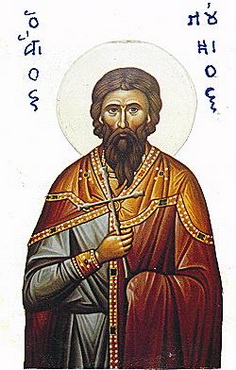 The Martyr Lucius, a senator, for confessing faith in Christ was beheaded by the sword on the island of Crete in the year 310. The Martyr Lucius, a senator, for confessing faith in Christ was beheaded by the sword on the island of Crete in the year 310.Martyrs Heliodorus and Dosa (Dausa) in Persia (380) The Martyrs Iliodoros and Dosos (or Dos) suffered for Christ in Persia under the emperor Sapor II, in the year 380. Martyr Photina, at the Church of Blachernae |
|||||||||||||||||||||||||||||||||||||||||||||||||
If You liked our Work and effort then please consider to make a kind donation:
 |
|||||||||||||||||||||||||||||||||||||||||||||||||||
If you like our project and you are satisfied with our work and effort, please consider making a donation that would help us to survive on the Internet and in further development of the project.
There are many other ways to help...